Chinese surveillance technology is being deployed across at least 11 African countries, and a new Institute of Development Studies study maps the contracts behind it. The research, published March 12, warns that the systems are being deployed to monitor activists and suppress political opposition. Reducing crime is the stated rationale; the IDS team found no effort to measure whether the systems actually achieve it.
The deeper finding is that China is exporting a full package for digital control, combining loans, infrastructure, training, and a propaganda narrative, sold to governments facing budget shortfalls and locked in through Chinese bank financing. The mechanics of that deal are spelled out in the Africa Defense Forum report on the IDS findings.
The $2 Billion Surveillance Map
The IDS study, led by digital research fellow Tony Roberts and Wairagala Wakabi, executive director of the Collaboration on International ICT Policy for East and Southern Africa in Uganda, identified nearly $2 billion in surveillance-related contracts across the 11 countries it examined. Roberts told Jeune Afrique for a May 28 article that the broader continental market could reach $10 billion.
The 11 countries are Algeria, Egypt, Kenya, Mauritius, Mozambique, Nigeria, Rwanda, Senegal, Uganda, Zambia, and Zimbabwe. Nigeria leads on spending, with more than $470 million invested and the largest smart camera network in the group. Guinea’s transitional council signed the most recent agreement on March 13, a $56 million deal. Typical national purchases have run between 2,000 and 5,000 cameras each, the report stated.
Those numbers do not cover every African country. They are the documented base the IDS team could verify across the 11 cases it examined.
The 11-country roster spans a wide stretch of the continent, from North Africa (Algeria, Egypt) to the Sahel (Senegal, Nigeria) to East and Southern Africa (Kenya, Uganda, Rwanda, Mozambique, Zimbabwe, Zambia), with Mauritius as the Indian Ocean outlier. The breadth of the list is itself part of the story: the IDS team did not find one or two isolated buyers but a regional pattern of procurement.
What a “City Brain” Actually Sees
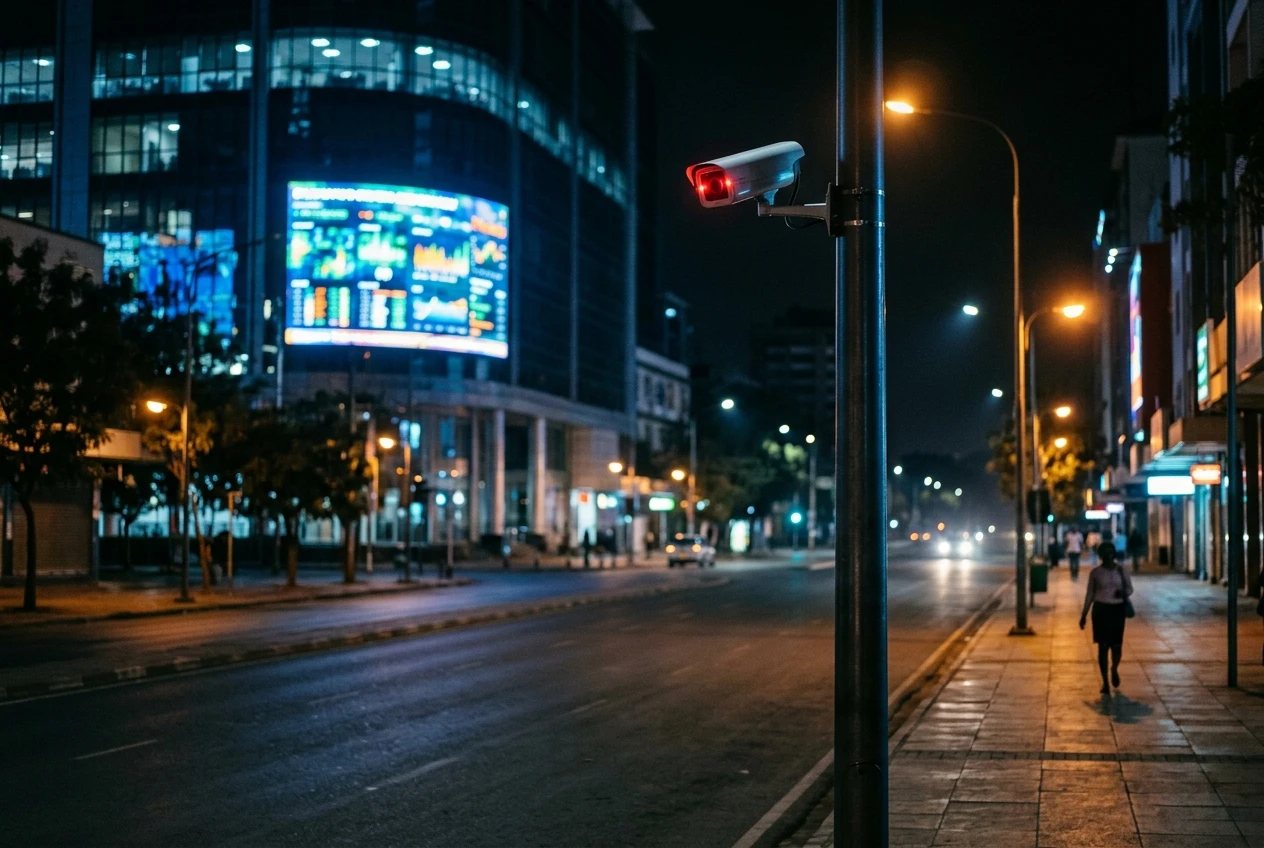
In each of the 11 countries, the cameras are not isolated devices. They feed into a centralized command center that Chinese tech companies, including Huawei and ZTE, refer to as a “city brain.” Artificial intelligence inside that network lets operators target and monitor individuals, merge the footage with databases such as identity registers, administrative files, driver’s licenses, and telephone records, and run facial recognition against those databases in near real time.
The IDS report describes the resulting networks as digital nervous systems that can constantly watch, aggregate, and analyze citizen activity to predict, prevent, and punish behavior authorities deem suspicious. Researchers pointed to the Republic of the Congo, where Chinese-built cameras have spread through high-traffic areas of Brazzaville and Pointe-Noire. Against a backdrop of that expanded monitoring, the IDS team noted several arrests of political opposition figures, journalists, and human rights activists.
The same contest over mobile surveillance towers and fresh privacy debates is now playing out in other markets, and the vendors on both sides of the Atlantic are largely the same.
Where the Money Comes From
China’s dominance of this market dates to 2015, when Beijing launched the Digital Silk Road, an extension of the Belt and Road Initiative. What the IDS team documented is that the appeal to African governments runs through the financing wrapped around the hardware. Private Chinese banks provide the funding to build and maintain the proprietary digital infrastructure, which means the debt itself is tied to the technology choice.
Bulelani Jili, a digital expert at Georgetown University who has researched Chinese technology exports to African countries, told Jeune Afrique that the offer is more complete than a sale. “China is not just selling cameras: it offers complete packages combining loans, infrastructure, training and technical assistance,” he said. The IDS authors wrote that these loans are conditional on the purchase of Chinese technology and services needed to build and transfer the “safe city” systems that the deployments are built around.
For governments facing budget shortfalls, that financing is the deciding factor. The conditional structure means the recipient country does not get to swap vendors, swap standards, or walk away from the underlying platform. Jili said Chinese infrastructure is more geared toward monitoring urban spaces, and that focus drives where the cameras get sited.
The result is a model where the camera, the loan, the training, and the standard are bundled into a single sale. Coverage of how Chinese technology trade is reshaping national security debates runs through the same set of vendors, and the same kind of package-style deal shows up in adjacent markets.
No Measure of Effectiveness, No Path to Redress
The IDS researchers made a pointed observation about how the projects are sold. In none of the 11 countries did they find any effort to measure whether the surveillance systems actually do what governments say they do. The stated goals, fighting crime and easing traffic congestion, are public interest talking points, not verified outcomes.
These projects are systematically presented as serving the public interest, fighting crime, easing traffic congestion, but in no country have we observed any effort to measure their effectiveness.
The accountability gap extends well past missing performance metrics. The IDS report said all 11 countries currently fail to provide adequate mechanisms for citizens to obtain remedy or redress in case of smart surveillance errors or abuse. The practical effects of that gap are concrete:
- Facial recognition can misidentify, and citizens wrongly flagged have no formal route to challenge the result.
- Police records, administrative files, and driver’s licenses get merged into a single searchable profile, with no clear audit trail.
- Journalists and opposition figures have been arrested in countries where Chinese-built cameras cover public spaces, the IDS research found.
The gap stays durable through the same financing structure that brought the cameras in. Once a city has taken the loan and built the command center, admitting a problem carries a political cost, and switching vendors carries a financial one, and both push back against reform.
Propaganda Frames the Debate
The final layer is the messaging around the systems. Marina Rudyak, a professor of Chinese foreign policy at Heidelberg University in Germany, told Jeune Afrique that the proliferation of these systems has sparked intense debate about ethical boundaries, but warned that Chinese propaganda is carefully deployed to control those very narratives.
The Chinese government does not present these technologies as authoritarian tools, but as instruments of stability, security and development. They fit within a model in which stability depends on controlling public space and the absence of social dissent.
That framing gives the package political durability inside recipient countries. The cameras arrive wrapped in a story about safety and modernization that domestic critics must argue against. The loans arrive with a development pitch. The absence of a remedy mechanism gets no public explanation, because citizens never see the inside of the system in the first place. Roberts and Wakabi published their findings on March 12, and the IDS team is now pushing the report through regional media and policy channels. None of the 11 countries has yet committed to measuring effectiveness, by the IDS team’s count.
Frequently Asked Questions
What did the IDS study actually find?
The IDS study identified nearly $2 billion in surveillance-related contracts tied to Chinese cameras in 11 African countries and concluded the deployments facilitate digital authoritarianism.
Which African countries were studied?
Algeria, Egypt, Kenya, Mauritius, Mozambique, Nigeria, Rwanda, Senegal, Uganda, Zambia, and Zimbabwe. Nigeria leads on spending and Guinea signed the most recent deal.
Who pays for the cameras?
Private Chinese banks extend the loans, and the IDS authors wrote that the borrowing countries must buy Chinese technology and services to build the so-called safe city systems.
Do citizens have any way to challenge abuse?
The IDS team said none of the 11 countries provides a working mechanism for citizens to challenge surveillance errors or file abuse claims.
How does the technology work?
AI-powered cameras feed into a centralized command center that Chinese vendors call a city brain, where facial recognition cross-references footage with identity registers, administrative files, driver’s licenses, and telephone records.