Esh-Tech raised $18 million in a funding round announced June 30, 2026, to scale production of DroneLight, its pulsed-laser counter-drone system unveiled at Eurosatory 2026 in Paris. Kinetica Ventures led the round, joined by Mahari, Renaton Capital, Q Fund, 2i Ventures, Hinkley, FFG, and a group of angel investors, with the Israel Innovation Authority also participating.
The investment follows the company’s recent public debut of DroneLight at the Paris defense exhibition. DroneLight runs on roughly 4 kilowatts of input power and can neutralize drones in one to two seconds, the company says. The system uses short pulses of light to drill physical holes into a drone’s structure; continuous-wave laser weapons burn through targets with a sustained beam. Riahi has described the configuration as three to four times less expensive than current laser or microwave systems. Esh-Tech has secured orders from customers worldwide, according to the company, without disclosing names or quantities.
The Pulse Difference in 10 Milliseconds
Most laser weapons in service today are continuous-wave systems that heat a single point on a target until structural failure sets in. Riahi says that process takes 10 to 15 seconds of sustained aim, during which the laser must remain locked on the same spot. Esh-Tech’s pulsed-laser approach fires 10-millisecond pulses at a 5 Hz repetition rate, with each pulse mechanically removing material from the target through ablation. Riahi compared the effect to firing bullets of light: each pulse drills into a drone’s structure, and the system concentrates additional pulses on the same point once a hole opens. “It’s like shooting, making holes in the target like a bullet, but with light,” Riahi told Breaking Defense.
Esh-Tech tested the configuration on more than 20 drones before its public unveiling. According to Riahi, between 5 and 10 holes are needed to hit a vital component, whether the battery, electronics, sensors, or camera, with near-certain kill probability. At a 5 Hz pulse rate and a one-to-two-second kill time, the company says DroneLight can neutralize up to 30 drones per minute.
The 4-kilowatt power draw is the figure that has drawn the most attention from military planners, since continuous-wave laser weapons in the same class typically require 20 kilowatts or more. That power ceiling forces competitors to mount their systems on vehicles with dedicated generators or on fixed sites with grid power. DroneLight’s optical head weighs around 450 kilograms, with a separate 350-kilogram support module that installs inside the host vehicle. Esh-Tech says the system can draw power from a tactical vehicle’s electrical system or run from a small 4 kWh battery for one minute of continuous operation. The system also reads the atmosphere in real time, identifying short “atmospheric windows” in which transmission conditions improve and timing its pulses to match.
| Specification | Value |
|---|---|
| Pulse duration | 10 milliseconds |
| Pulse repetition rate | 5 Hz |
| Input power | ~4 kW |
| Kill time per drone | 1 to 2 seconds |
| Engagement rate | Up to 30 drones per minute |
| Effective range | ~1 km |
| Optical head weight | ~450 kg |
| Support module weight | ~350 kg |
| Operator | Single user |
The Syndicate Behind the $18M Round
The structure of the round is a deliberate mix of venture capital, corporate venture, and public capital. Kinetica Ventures, the defense-tech VC firm that led the round, also brought in operational support alongside its capital, Landau said. The Israel Innovation Authority, the government body that supports Israeli industrial R&D, also participated, with Esh-Tech describing the involvement as “meaningful,” per the company’s announcement on the DroneLight round.
Kinetica is run by Aaron Applbaum, Yoav Knoll, Frederic Landau, and Brig. Gen. (res.) Amit Kunik, a former senior commander in Israel’s intelligence community, and is chaired by veteran investor Yitz Applbaum, a co-founder of Lightspeed Israel. The fund’s existing portfolio includes Particle, Line5, and Limitless CNC, and its focus spans advanced manufacturing, artificial intelligence, electronic warfare, unmanned systems, and space. Landau said the fund will help Esh-Tech enter European and US markets using Kinetica’s industry expertise, operational experience, and strategic-partner network. The fund’s focus on unmanned systems and electronic warfare overlaps with Esh-Tech’s positioning, per the press release.
Participants in the round, per Esh-Tech’s announcement:
- Kinetica Ventures (lead)
- Mahari
- Renaton Capital
- Q Fund
- 2i Ventures
- Hinkley
- FFG
- Angel investors
- Israel Innovation Authority (meaningful participation)
This investment marks an important milestone for Esh-Tech as we move from development to large-scale deployment. The confidence shown by investors from leading global markets is a strong validation of our technology and its ability to address one of the most significant challenges facing modern armed forces.
Erez Riahi, chief executive of Esh-Tech, in the funding announcement.
Why the Drone Threat Is Pulling the Capital
The drone threat has shifted from nuisance to operational priority across multiple theaters, and that shift is the undercurrent running through this round. The Israel Ministry of Defense’s Directorate of Defence Research and Development (MAFAT) is cooperating with Esh-Tech on potential integration into Israel’s own defense requirements, Riahi told Breaking Defense. Esh-Tech was selected months ago for MAFAT’s Mafat for Startups program, which provides up to NIS 10 million in support per selected company, according to Globes.
That government backing sits alongside commercial demand: Esh-Tech says it has received “significant orders from customers worldwide,” without naming buyers or volumes. Riahi has identified the United States, Europe, Latin America, and Asia-Pacific as priority customer regions.
The cost story is the part of the pitch that travels. Esh-Tech told Globes that DroneLight costs about NIS 0.10 per minute of operation, against the per-shot economics of kinetic interceptors. At the system level, the company says DroneLight costs roughly 25 percent of comparable continuous-wave laser effectors, per EDR Magazine. The Israeli defense establishment has also put money where the rhetoric sits: Iron Beam, the laser built by Rafael Advanced Defense Systems, was delivered to the IDF “five months ago,” Globes reported.
The round arrives as militaries and governments spend heavily on counter-drone capabilities, with the directed-energy weapons segment that DroneLight sits in among the fastest-growing areas of defense technology, per EDR Magazine. The broader demand surge for directed-energy counter-drone systems has been tracked by Forecast International as the threat has spread beyond Ukraine. Riahi has tied the company’s work directly to the operational pressure from drone warfare, telling Breaking Defense, “I have children in combat units, and it is important to find a solution to this threat.” Esh-Tech expects to scale from dozens of systems in early 2027 to hundreds of units annually the following year, Riahi told Breaking Defense.
From R&D to a Production Line
The capital gives Esh-Tech a runway to convert its working prototype into a deployable product line. According to the company, the funding will support the establishment of an Israeli production line, completion of remaining development activities, recruitment of additional personnel, and expansion of international sales and delivery operations. Esh-Tech employs about 20 people at its Omer premises, with plans to move some staff to Modi’in.
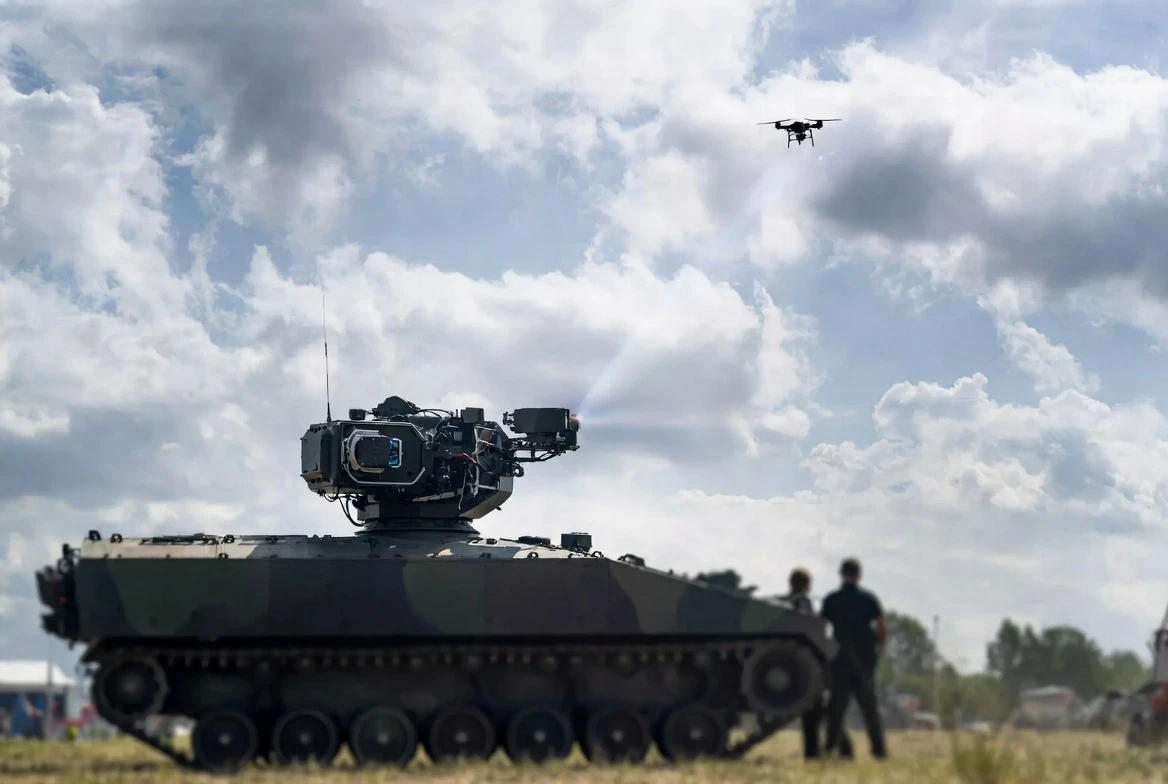
The first operational DroneLight system is set to be ready in October 2026, Riahi told Breaking Defense. The system was previously tested on an undisclosed vehicle in Israel, where it destroyed 20 drones, the company has said. The production roadmap calls for scaling from dozens of systems in early 2027 to hundreds of units annually the following year, with Riahi pursuing customers across the United States, Europe, Latin America, and Asia-Pacific. Esh-Tech is cooperating with Israel Ministry of Defense’s MAFAT on potential integration into Israel’s defense requirements. The system was demonstrated at Eurosatory 2026 mounted on FFG’s tracked armored vehicle, giving the company a public reference platform for international buyers.
Landau added that Kinetica would help Esh-Tech enter European and US markets using the fund’s industry expertise and strategic-partner network. The fund’s portfolio in adjacent defense-tech segments includes Particle, Line5, and Limitless CNC, per the Esh-Tech press release.
Our investment in Esh-Tech reflects our commitment to supporting breakthrough technologies that have the potential to redefine their market. Esh-Tech combines deep expertise in laser technologies with a strong understanding of operational requirements, resulting in a solution that addresses a critical and rapidly evolving challenge.
Frederic Landau, General Partner at Kinetica Ventures, in the funding announcement.
The Competitive Question the Bet Still Has to Answer
DroneLight is not the only laser counter-drone system chasing the demand pull. Rafael Advanced Defense Systems’ LiteBeam, a laser that uses 10 kilowatts of power, was rolled out in October 2024 to protect vehicles from drone threats, Breaking Defense reported. Rafael’s larger Iron Beam system was delivered to the IDF earlier this year, per Globes.
DroneLight’s positioning against those systems runs on three numbers: 4 kilowatts of input power versus Rafael’s LiteBeam at 10 kilowatts, a per-minute operating cost of roughly NIS 0.10 versus the recurring cost of kinetic interceptors, and a system price the company places at about 25 percent of conventional continuous-wave laser effectors. Esh-Tech’s claims about its system have not yet been publicly validated at large scale, Techtime noted, and the company says DroneLight is undergoing evaluation processes in several countries. The system is rated TRL8, one step away from full operational maturity. Riahi has named the United States, Europe, Latin America, and Asia-Pacific as the customer regions the company is pursuing.
The challenge for Esh-Tech is converting a working prototype into a product line that militaries can buy at scale. The optical head alone weighs around 450 kilograms, with a separate 350-kilogram support module that installs inside the host vehicle, which constrains how the system can be mounted. DroneLight’s mobile-configuration advantage of drawing power from a tactical vehicle’s electrical system only matters if the host platform can carry the weight and provide the juice. The company is also pursuing a lighter configuration for jeeps and a fixed-site variant, which would broaden the addressable market. Esh-Tech has signaled the production ramp: dozens of systems in early 2027, hundreds annually the following year.
“I have children in combat units, and it is important to find a solution to this threat,” Riahi told Breaking Defense. Esh-Tech plans to sell hundreds of systems a year and is working closely with customers to provide a complete solution, the company has said.
Frequently Asked Questions
What is DroneLight and how does it work?
DroneLight is a pulsed-laser counter-drone system developed by Israeli company Esh-Tech Systems. The system fires 10-millisecond pulses at a 5 Hz repetition rate to neutralize drones in one to two seconds, the company says, and is rated TRL8, one step away from full operational maturity. Riahi told EDR Magazine that between 5 and 10 holes drilled into a drone are needed for a near-certain kill.
How much did Esh-Tech raise and who led the round?
Esh-Tech raised $18 million in a round announced June 30, 2026, led by Kinetica Ventures. Joining Kinetica were Mahari, Renaton Capital, Q Fund, 2i Ventures, Hinkley, FFG, and a group of angel investors, with participation from the Israel Innovation Authority.
How does DroneLight compare to Rafael’s laser systems?
DroneLight runs on roughly 4 kilowatts, versus 10 kilowatts for Rafael’s LiteBeam. Riahi told Breaking Defense that DroneLight is three to four times less expensive than current laser or microwave systems, and EDR Magazine reported the system costs around 25 percent of comparable continuous-wave laser effectors.
When will the first DroneLight system be operational?
The first operational DroneLight system is set to be ready in October 2026, Erez Riahi told Breaking Defense. Esh-Tech expects production to scale from dozens of systems in early 2027 to hundreds of units annually the following year.
Where is Esh-Tech based, and who founded it?
Esh-Tech is based in Omer, Israel, with plans to move some staff to Modi’in. The company employs about 20 people and was founded by Erez Riahi, a former executive at the TAMAM division of Israel Aerospace Industries, who wrote on LinkedIn that he left a ‘comfortable career in the defense industry’ because ‘I believed there was a problem that nobody was truly solving.’