Technology leaders, academics, investors, and entrepreneurs gathered at the Tech Derby Conference 2026 in Derby on June 15, calling for stronger artificial intelligence governance, deeper investment in digital skills, and tighter industry-academia collaboration to drive the East Midlands’ next phase of digital economic growth. The conference, themed “AI & the Next Digital Economy: Innovation, Opportunities and Responsible Governance,” placed governance ahead of growth messaging and positioned a regional hub against a UK AI economy where London still anchors most of the capital, compute, and senior talent. The day’s working assumption was that the regions that answer the same governance questions first will win the contracts that follow.
The conference’s opening session set the tone. Adepeju Bello, Director at Tech Derby and Head of the Tech Advisory & Policy Group, moderated the central panel, which examined accountability, transparency, data governance, and human oversight as the conditions for any regional AI bid. The day’s structure mixed panels with keynotes, product demonstrations, and a startup pitch competition. Programme sessions covered AI in music education, agentic AI for small businesses, and a keynote on local talent development from the University of Derby. The conference ran as the opening day of the East Midlands Tech Week festival listing, a five-day festival running Monday, June 15 through Friday, June 19 across venues in Derby, Nottingham, and Leicester.
What Happened at Vaillant Live
The Tech Derby Conference 2026 opened at Vaillant Live, a converted venue in Derby city centre, on Monday, June 15. The event’s branding carried the theme “AI & the Next Digital Economy: Innovation, Opportunities and Responsible Governance” across backdrop banners, badges, and the printed programme. A Tech Derby Startup Pitch Competition and Innovation Award 2026 ran alongside the main conference, with early-stage founders from across the region pitching to a panel of investors. The day’s structure mixed panels with keynotes and product demonstrations, with sessions explicitly designed to surface AI governance, talent development, and practical AI adoption in regional businesses.
Akindayo Akindolani, CEO and co-founder of Tech Derby, opened the day by framing the conference as a working session rather than a launch event. Olawale Olatunji, Co-Founder and Event Project Manager, hosted the panels and introduced each speaker. The pair have built Tech Derby into a regional community organisation through monthly meetups, accelerator programmes, technical training, and partnership work with the University of Derby and other regional backers.
The conference ran from morning to late afternoon, with the Tech Derby Startup Pitch Competition and Innovation Award 2026 running concurrently in a separate hall. Tech Derby operates through monthly meetups, accelerator programmes, technical training, and partnership work, and the 2026 conference was designed to sit on top of that existing regional infrastructure. The conference’s mix of partners, from East Midlands Tech Week to British Business Bank, was its strongest evidence that it could move from rhetoric to delivery. The day’s attendance drew founders, students, investors, academics, and technology professionals from across the East Midlands, with sessions deliberately aimed at the regional audience Tech Derby has been building through its monthly meetups.
Why Governance Led the Day
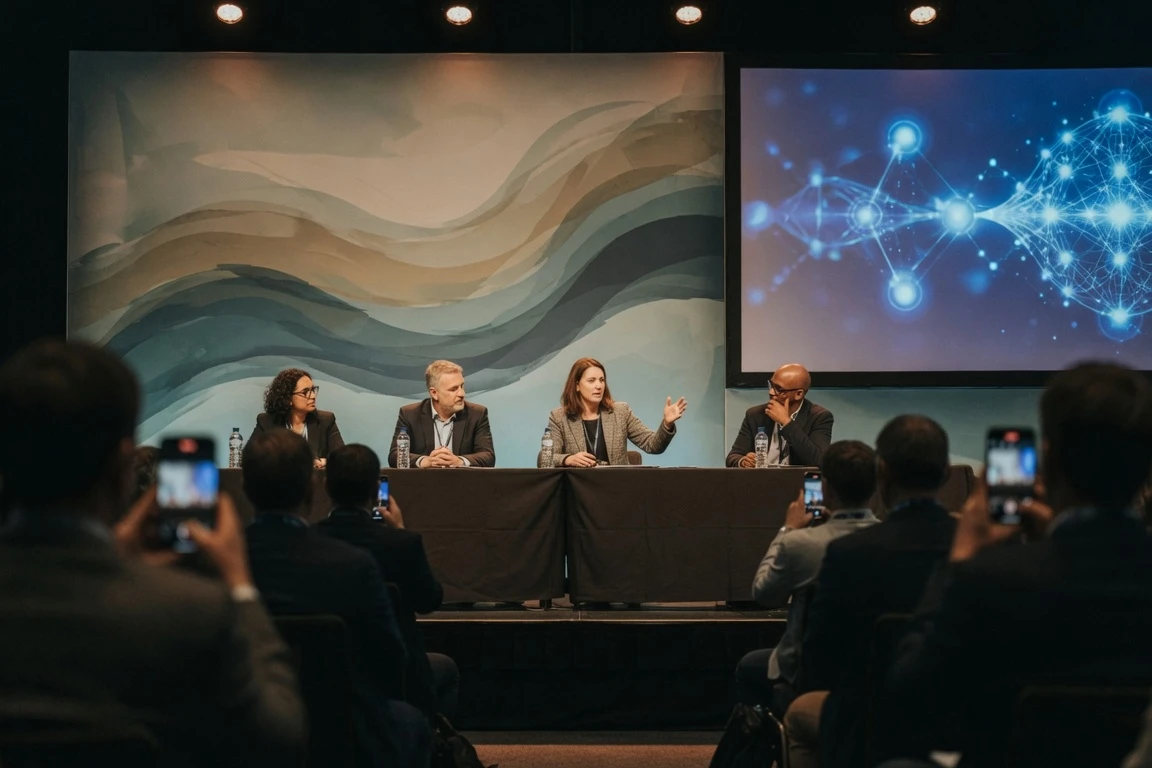
Governance led the day’s agenda, and the choice itself signals how the region’s AI pitch is being positioned. Bello, a cybersecurity and financial crime specialist by training, opened the central panel by arguing that artificial intelligence had already moved past the conceptual stage. Her argument was that the buyers, regulators, and bank compliance teams who decide where AI capacity gets deployed are asking the same questions at the same time. That framing pushed accountability, transparency, data governance, and human oversight to the top of the panel’s working list, ahead of growth metrics and founder stories. The conference’s working assumption was that the regions that answer these four questions first will win the contracts.
Artificial Intelligence is no longer a future technology, it is already transforming how we work, learn, communicate, make decisions, and build businesses. From healthcare and finance to education, government, and entrepreneurship, AI is creating incredible opportunities for innovation and growth.
Bello, Director at Tech Derby and Head of the Tech Advisory & Policy Group, made the argument at the AI Governance and Responsible Innovation panel. She also runs the cybersecurity and financial crime advisory work that frames the governance questions for the conference. The opening was a deliberate choice to lead with governance rather than growth.
Rukayat Balogun added that meaningful human oversight is the hardest of the four concepts to demonstrate to enterprise buyers. She argued that small and medium-sized businesses that handle customer data without dedicated compliance teams face the steepest learning curve. Joseph Origbo, PhD Researcher and Co-Founder of Tech Derby, said responsible innovation only works when universities, businesses, public-sector bodies, and technology leaders collaborate on the ground. Origbo framed it as a multi-stakeholder problem with no single actor able to carry it alone.
Origbo closed the governance block with a sharper framing. He said technological progress alone would not be enough to build a competitive digital economy in the region. Sustained investment in skills development, partnerships, and trust would decide whether innovation produced inclusive economic growth, he said. The argument sat at the centre of the conference because every East Midlands bid for funding, compute, or training programmes now faces the same test. The conference’s academic anchor on the talent question came from Professor Stephan Reiff-Marganiec, Head of the School of Computing at the University of Derby.
Skills Built Close to Home
Local talent, not imported talent, is the bet the conference made on its second pillar. Reiff-Marganiec’s keynote on developing local talent for an AI-ready future was positioned as the academic answer to the workforce question the governance panel had raised. The University of Derby’s School of Computing, which Reiff-Marganiec leads, is the academic anchor the conference is calling on regional employers to recruit from. The argument the conference made is that the East Midlands can grow its own AI workforce if universities, businesses, and local communities share the work.
Origbo, whose PhD research focuses on AI and digital innovation, added that closing the regional skills gap sits across universities, businesses, and the public sector together. He framed skills development, partnerships, and trust as equally important to building a competitive digital economy, alongside the technology itself. The framing was reinforced by the partner list, with the University of Derby as an academic partner alongside the capital providers.
Preparing the workforce for an AI-driven economy would require stronger partnerships between universities, businesses, and local communities.
Reiff-Marganiec, Head of the School of Computing at the University of Derby, made the workforce point in his opening keynote. He argued that developing local talent was critical to ensuring people could take advantage of emerging technological opportunities as AI adoption accelerates across industries. The argument sat between the governance panel’s enterprise-buyer framing and the partner list’s capital framing. The conference has not yet disclosed cohort sizes or training delivery metrics for the next year. That is the gap the East Midlands bid will need to close if it is to compete with London-based AI skills programmes for the government’s 10 million worker training target by 2030, as detailed in this AI workforce transformation playbook from Berlin.
On the Floor, AI Beyond the Slides
Ajibola Shokunbi of AudioInsight UK brought a working product to the conference, an application of artificial intelligence to music education. He demonstrated how research-led innovation in audio analysis can become a practical commercial tool with real-world impact. The point of bringing a product rather than a slide deck was to argue that academic work in the East Midlands can be translated into real businesses.
Adrian Pinder, Co-founder of Machine Mesh AI, and software developer Omolara Oladipupo rounded out the practical AI track. Oladipupo spoke on building competitive businesses in the digital economy, highlighting emerging technologies such as agentic AI. She urged small and medium-sized businesses to monitor new digital tools that could improve productivity, competitiveness, and long-term growth over the next five years. The session was deliberately aimed at founders who are not yet AI-native, the segment Tech Derby says is the bulk of its regional audience, and the same audience that has prompted a balanced AI adoption call in freight technology from peer industries.
The East Midlands Push Against London Gravity
The clearest statement of the regional bid came from Akindolani, CEO of Tech Derby, in his post-conference comments. “AI and digital innovation must not be something that happens only in London or larger cities,” Akindolani said, arguing that Derby has the talent, the ideas, and the ambition to play a serious role in the next digital economy. The argument is regional rather than parochial: Tech Derby is positioning Derby as a credible alternative hub for founders, investors, and skilled workers priced out of the capital’s tech corridor. The conference framed the regional claim around governance, talent, and partnerships rather than capital alone, because capital is the variable the East Midlands cannot move on its own. The framing matters because London still anchors most of the UK’s AI investment, senior talent, and large enterprise buyers, the same gravity that any regional tech hub faces, from Derby’s bid to Ho Chi Minh City’s 2030 regional tech hub plan.
Olawale Olatunji, Co-Founder and Event Project Manager, made the same point in his closing comments about the region’s potential. He said the discussions around AI, responsible innovation, digital skills, and business growth had reinforced the case for the East Midlands to become a leading technology hub. The argument cuts both ways: regional conferences succeed when they turn rhetoric into named hires, named investments, and named programmes. The Tech Derby 2026 conference has not yet disclosed follow-on metrics.
The push lands at a moment when UK AI policy has begun talking the same language about regional growth. Capital, senior talent, and compute still concentrate in London, and the East Midlands will need sustained partner support to compete on those terms. The next two sections test what is actually on the table: the partner list and the national plan above the region.
Already running monthly meetups, startup support programmes, and pre-seed acceleration work, Tech Derby has an existing regional infrastructure that the conference is layered on top of. That infrastructure is what differentiates the East Midlands’ bid from a one-off regional event. Converting that infrastructure into named AI Growth Zone participation or regional compute allocation is the next test for the partner list and the national plan. Akindolani said the next round of activity will focus on founder support, AI workshops, and youth-focused digital initiatives, with conference programmes continuing across the year. Whether those programmes produce named AI Growth Zone participation or regional compute access is the test for the year ahead.
The Money Behind the Movement
The conference was supported by a roster of named partners spanning academia, capital, and community work. East Midlands Tech Week, the University of Derby, British Business Bank, Mercia Ventures, LemFi, TES Community, and other members of the local innovation ecosystem were listed as backers. Each partner brings a different lever to the regional AI buildout, and the list is the conference’s most concrete commitment beyond the panel discussions. The mix matters because the East Midlands cannot solve the regional AI bid with conferences alone, and the partner list is the next test of whether the conference’s rhetoric lands in named programmes.
- East Midlands Tech Week: ran 15-19 June 2026 as the umbrella festival
- University of Derby: academic partner, home of the School of Computing
- British Business Bank: listed capital partner
- Mercia Ventures: listed capital partner
- LemFi: listed partner
- TES Community: listed community partner
The academic partner, the University of Derby, runs the School of Computing that Reiff-Marganiec heads and is the regional pipeline the conference is calling on employers to hire from. The capital partners, British Business Bank and Mercia Ventures, are the regional growth funders most likely to write the cheques that follow the conference. The community partners, LemFi and TES Community, link the conference to the founders and career switchers Tech Derby says are its core audience. The full partner roster and the day’s session grid are listed in the Tech Derby Summit 2026 event listing.
Education, banking, fintech, and community organisations are the sectors the conference’s governance argument called out as priority buyers for regional AI, and the partner list covers each of them. Each partner represents a different route from regional AI training into named jobs and named contracts, and that breadth of sectors is the argument Tech Derby is making for delivery. Follow-on funding rounds, cohort sizes, or training delivery targets tied to the named partners have not been disclosed by the conference. Akindolani said Tech Derby would continue expanding programmes focused on AI training, startup support, technical education, hackathons, and ecosystem partnerships, with the partner roster expected to grow through the year. The next test for the East Midlands’ AI bid sits in the numbers attached to those programmes, not in the partner logos on the conference backdrop.
Where the National AI Plan Lands
The Tech Derby push sits inside a UK government AI policy that has begun to back regional development in both words and money. The AI Opportunities Action Plan: One Year On, published by the Department for Science, Innovation and Technology in January 2026, reports that 38 of the Plan’s 50 actions have been delivered. The Plan commits £500 million of government funding to a new Sovereign AI Unit to invest in domestic AI companies. It also backs the National Data Library with over £100 million at Spending Review 2025. The headline figures are national, but the regional argument is the one Tech Derby is trying to attach Derby to.
- 38 of 50 actions delivered under the AI Opportunities Action Plan
- £28.2 billion in private investment unlocked across AI Growth Zones
- 5 AI Growth Zones designated across Great Britain
- 1 million AI upskilling courses delivered, toward a 10 million worker target by 2030
- £500 million backing the Sovereign AI Unit to invest in UK AI companies
Five AI Growth Zones have been announced so far, and none of them are in the East Midlands. The Plan’s named compute build-out sites are also outside the region. For a regional conference to compete for follow-on investment, the Derby pitch needs to convert its governance and skills language into named data centre capacity, named compute allocations, and named training cohort sizes. The £28.2 billion in private investment that the Plan has already unlocked sits in zones the East Midlands bid has to compete for rather than benefit from by default.
The Plan also commits to upskilling 10 million UK workers in AI skills by 2030, with over 1 million AI courses already delivered through industry partners. That training pipeline is the variable the East Midlands could realistically access, and Tech Derby’s founder support and AI workshops are the natural place to plug into it. Reiff-Marganiec’s argument about local talent development is the bridge between the national training pipeline and the regional skills push. The bridge has to be built before the next round of AI Growth Zone designations, with the AI Growth Zone Delivery Unit now operational and brokering power, planning, and offtake across the first wave of Zones, as set out in the UK government’s AI Action Plan one-year update.
Akindolani said Tech Derby would continue with AI training, startup support, technical education, hackathons, and ecosystem partnerships through the year. The conference has put a regional bid on the table, and the bid now waits on whether the national policy machinery reaches the East Midlands with capital, compute, and cohort sizes rather than just the language of regional growth. The Plan’s January 2026 update set a public dashboard for tracking the remaining 12 actions, which is the public scoreboard Tech Derby and every other regional conference will be measured against.
Frequently Asked Questions
What was the Tech Derby Conference 2026?
The Tech Derby Conference 2026 was a one-day regional technology conference held at Vaillant Live in Derby on Monday, June 15. It ran as the opening event of the first East Midlands Tech Week, a five-day festival running Monday, June 15 through Friday, June 19 across venues in Derby, Nottingham, and Leicester. The conference’s stated theme was “AI & the Next Digital Economy: Innovation, Opportunities and Responsible Governance.” The day’s programme mixed keynotes, governance panels, talent sessions, and product demonstrations.
Who organised Tech Derby 2026?
Tech Derby organised the conference, with Akindayo Akindolani as CEO and Olawale Olatunji as Co-Founder and Event Project Manager. The organisation is a Derby-based technology and innovation community that runs monthly meetups, accelerator programmes, technical training, and partnership work with regional backers. The 2026 conference was supported by East Midlands Tech Week, the University of Derby, British Business Bank, Mercia Ventures, LemFi, and TES Community.
Why is governance leading the East Midlands AI pitch?
Speakers including Adepeju Bello argued that accountability, transparency, data governance, and human oversight are the conditions regulators, banks, and large enterprise buyers ask for before committing capital to AI adoption. The argument is particularly relevant for regional SME supply chains, which often lack dedicated compliance teams. The conference placed governance ahead of growth metrics in its framing, and the decision matters because regions that can answer the four governance questions first are likely to win the contracts that follow.
How does the Tech Derby push connect to the UK AI Opportunities Action Plan?
The UK government published the AI Opportunities Action Plan: One Year On in January 2026, reporting that 38 of the Plan’s 50 actions have been delivered. The Plan has unlocked £28.2 billion in private investment across five AI Growth Zones and links the programme to 15,000 jobs. It also commits £500 million to a Sovereign AI Unit, £100 million to the National Data Library, and upskilling 10 million UK workers in AI skills by 2030. Tech Derby’s regional bid is positioning Derby to compete for follow-on funding and compute allocations through these national programmes. The next round of AI Growth Zone designations is the specific window the East Midlands bid is targeting.
What programmes will Tech Derby run next?
Akindolani said Tech Derby would continue with AI training, startup support, technical education, hackathons, and ecosystem partnerships through the year. The next round of activity will focus on founder support, AI workshops, and youth-focused digital initiatives. The Tech Derby Startup Pitch Competition and Innovation Award 2026 ran alongside the main conference and is expected to continue as an annual event. The conference’s partner list is expected to grow as regional AI programmes expand.