A revolutionary safety technology from Hyundai Motor Company and Kia Corporation called Vision Pulse aims to dramatically reduce tragic accidents in school zones and other high-risk areas by detecting vulnerable road users in real time. The system uses ultra-wideband wireless signals to pinpoint the position of people, bicycles, and other vehicles even when they are hidden from view, offering a new layer of protection beyond traditional sensors. Early demonstrations show how this could transform road safety for children and commuters alike.
In the United States alone, thousands of pedestrians, including children, are injured or killed in vehicle collisions each year, especially in school zones where visibility and distracted driving heighten risk. Vision Pulse could provide a technological countermeasure to these heartbreaking losses by issuing timely alerts that give drivers precious extra seconds to react.
How Vision Pulse Sees What Others Cannot
Vision Pulse represents a significant leap beyond current driver assistance systems by using ultra-wideband (UWB) signals to detect objects around a vehicle even when they are not in the driver’s line of sight. Unlike traditional radar or camera-based sensors that require a clear visual path, UWB signals can penetrate obstacles like other vehicles or structures, giving the system insight into areas that would otherwise be blind spots.
UWB modules emit low-power radio waves that interact with any nearby device equipped with compatible UWB technology, such as modern smartphones, smartwatches, or dedicated trackers. By measuring how long it takes for these signals to travel back and forth, Vision Pulse can calculate the precise location of pedestrians or other road users with remarkable accuracy. According to Hyundai and Kia, this positioning can be accurate to within about 10 centimeters over a 100-meter radius and maintain over 99 percent detection accuracy even in poor weather or at night.
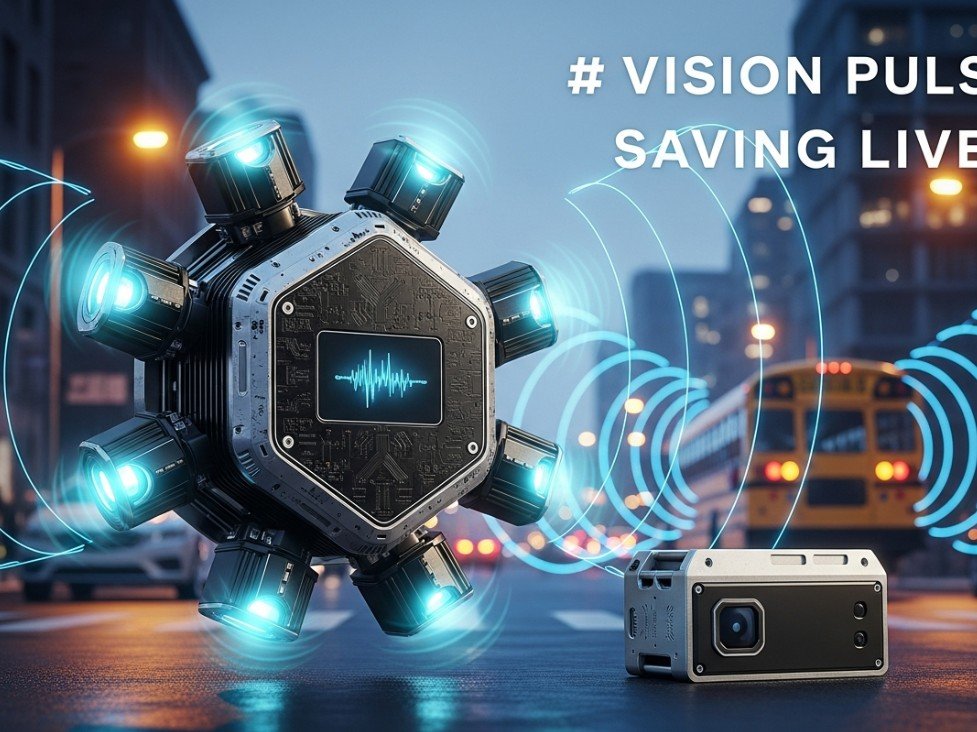
Rapid communication speeds of 1 to 5 milliseconds further enhance the system’s real-time capability, crucial in scenarios where every millisecond counts. Vision Pulse also uses predictive algorithms designed to track multiple objects simultaneously, allowing it to anticipate movement rather than simply reacting after something enters view.
Focus on School Zone Safety and Vulnerable Road Users
One of the most compelling early use cases for Vision Pulse is in school zone safety. Automakers showcased the technology in a campaign video highlighting how it could be applied to school buses. In this scenario, children carry small UWB-enabled keyrings attached to backpacks, designed with a guardian angel motif to make them appealing and easy to keep on personal belongings. The signals from these keyrings allow the system to map out where children are in relation to the bus, even if they are hidden behind other vehicles or objects.
This approach directly targets a persistent danger: children’s small size and unpredictable movement patterns often put them at high risk in traffic, particularly during boarding and drop-off times in school zones. Traditional driver assistance systems can miss these moments because they depend upon cameras or radar line of sight. Vision Pulse’s ability to sense around obstacles and alert bus drivers or nearby vehicles could significantly reduce these dangerous blind spots.
Child safety advocates and traffic safety experts have long stressed the need for improved protection in school zones, as statistically children account for a disproportionate share of pedestrian casualties involving vehicles. While exact figures vary by region, data from traffic safety authorities indicate that vulnerable road users frequently feature in collision statistics, underscoring the urgency for better detection systems.
Beyond Cars Schools and City Streets
While school buses represent a highly visible demonstration, Vision Pulse’s potential extends far beyond. Hyundai and Kia are exploring applications in a variety of environments:
-
Urban driving corridors where cyclists and pedestrians mix with heavy traffic and line-of-sight challenges are common.
-
Industrial settings, such as warehouses or factory floors, where forklifts and workers must avoid collisions.
-
Port terminals, with ongoing trials at large logistics centers in South Korea to prevent accidents in cluttered environments.
-
Disaster response scenarios, where UWB could help locate victims trapped under debris after earthquakes or structural collapses.
A key advantage of the system is its compatibility with existing hardware. Vehicles equipped with Hyundai and Kia’s Digital Key 2 already contain UWB modules, meaning Vision Pulse could be enabled in cars without significant added cost or complex retrofits. This contrasts with other advanced sensors like LiDAR, which can be expensive and bulky.
Where Vision Pulse Stands Today and What Comes Next
Despite its promise, Vision Pulse is still in the pre-development stage. Automakers emphasize that while trials and pilot programs are underway, including at Kia’s PBV Conversion Center and the Busan Port Authority, it has not yet been finalized for mass-market vehicles. Commercial deployment will depend on further testing, validation, and potentially broader adoption of UWB technology in devices carried by pedestrians and cyclists.
Industry experts see Vision Pulse as part of a broader trend toward vehicle to everything connectivity, where cars communicate with people, infrastructure, and other machines to enhance safety and efficiency. The National Highway Traffic Safety Administration and safety boards have long pointed to the potential of connected systems to reduce crashes significantly when widely adopted.
However, Vision Pulse also faces challenges. It requires vulnerable road users to carry UWB-enabled devices to be effective, and widespread adoption of such devices is not guaranteed. Additionally, regulatory frameworks and privacy concerns around real-time tracking must be addressed before full deployment. Despite these hurdles, the technology represents a major step in integrating advanced wireless sensing into mainstream mobility safety suites.
As communities grapple with the persistent danger of pedestrian accidents, especially around schools and city centers, Vision Pulse offers a new lens on safety: one that could help vehicles sense what the human eye cannot. If widely adopted, it may not just save seconds in a near-miss but save lives in moments that currently end in tragedy.
At a time when road safety remains a global public health focus, this innovation highlights how technology can bridge human limitations and protect the most vulnerable among us.