Accra woke to flooded highways on Monday morning after overnight rains submerged the roads that carry the week’s perishable supply into the capital. The deluge began late on Sunday, June 28, and ran into the Monday rush, blocking the Nsawam-Pokuase highway and bringing traffic to a halt across several arterial roads. Tomato transporters heading into Accra found themselves parked mid-route at Nsawam, waiting for the water to recede. Muntaka Mohammed-Mubarak, the Interior Minister, asked residents of Accra to work from home and warned that heavier rain was still on the way.
Tomatoes are the most visible casualty of a flood timed for the worst possible day. Mondays are when vehicles move commodities from rural Ghana into Accra and Kumasi for the week’s trading, and the Tomato Transporters Association of Ghana said its drivers had no way to reach the central markets. The president of the association told Luv Business the trucks had simply pulled over to wait out the flood. The Interior Minister’s work-from-home directive has compounded the disruption across the capital.
Accra’s Supply Routes Drowned Overnight
The flooding followed hours of rain that began on Sunday night and continued into the Monday morning rush, according to a MyJoyOnline report on the trucks stranded on Accra’s flood-hit roads. By dawn, the floodwaters had entered homes and offices and crossed the carriageway of the highway near Pokuase, splitting the road in two. Motorists sat in queues running in both directions, and vehicles trying to push through found water already at axle height. At the Tomato Transporters Association, phones rang through the morning with drivers reporting the same picture from different points along the corridor.
The rains, as weather forecasters had predicted, were forecast to continue until midday, leaving drivers and their cargoes stuck in place. Forecasters told residents to prioritise personal safety over the usual Monday commute. The morning rush that residents expected to navigate was replaced by long queues through standing water.
For traders carrying tomatoes into Accra, the morning deadline for getting goods to market had already gone. The window for offloading perishable cargo on Monday is narrow, and the flooding has effectively closed it. Trucks that left rural Ghana in the early hours are now sitting idle on a road that gives no way around the water. Without the morning auctions, the load loses its window for sale.
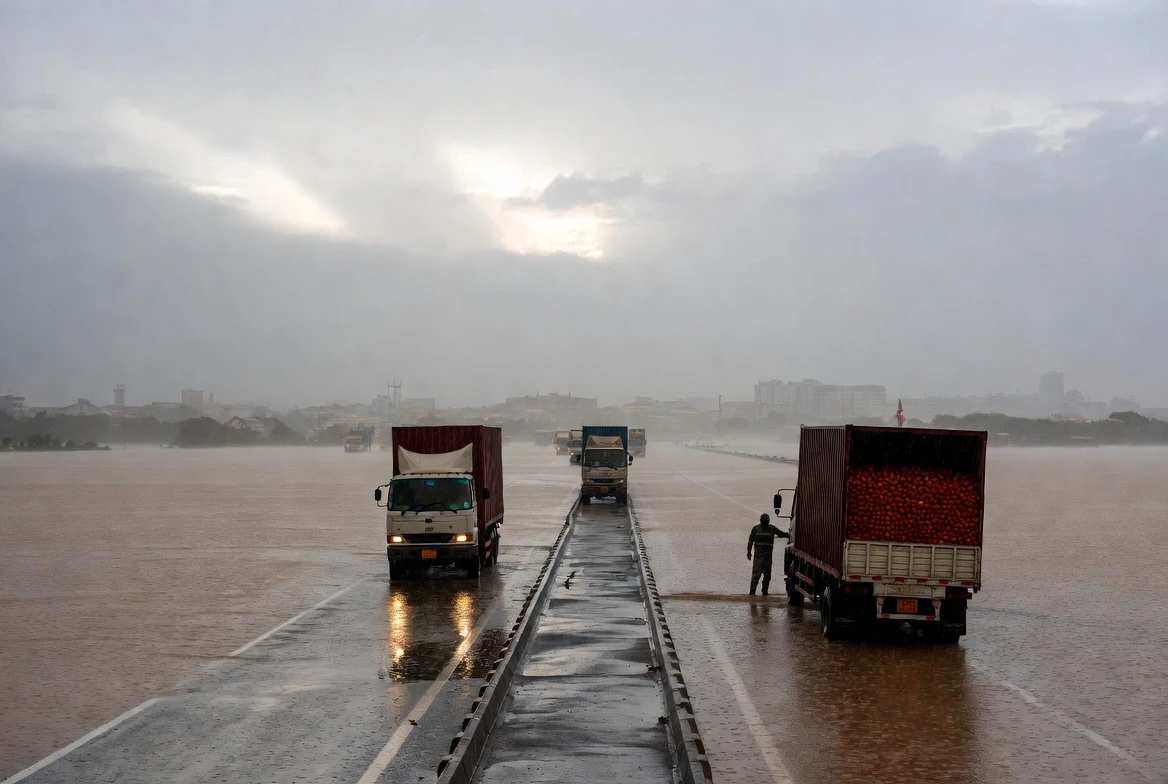
Tomato Trucks Parked Mid-Road at Nsawam
The trucks had been calling in to their association since early morning. Drivers stuck at Nsawam reported the Pokuase road was inundated, with no vehicle able to move to access the market centre. Their association’s president described the scene as drivers pulled over to wait for water to recede. Drivers who set out in the dark were now sitting still as the sun rose. Those who tried to push through found the road ahead closed.
One of the drivers called me and said they are stuck at Nsawam because the Pokuase road is now inundated with no vehicle able to move to access the market centre. All our big markets are in Accra central and since it’s flooded, what they can do is to just park.
The remarks came from Eric Tuffour, president of the Tomato Transporters Association of Ghana, in an interview with Luv Business, the JoyNews programme that covers trade and industry. The association represents drivers who move tomatoes from rural farming belts into the capital’s central markets, where Monday is the heaviest movement day of the week. The cargo they carry is meant for the morning auctions, before the heat of the day can spoil the fruit. With the trucks at a standstill, the tomatoes in their holds will not reach buyers before they spoil.
Accra’s Roads Under Water on Monday
The flooding was not confined to the Pokuase corridor. According to a Citi Newsroom report on the list of flooded roads across Accra on Monday, the early-morning deluge submerged sections of the N1 Highway and left several arterial routes impassable. Commuters struggled to reach work and school through waterlogged streets, and some motorists abandoned their vehicles to seek higher ground.
The report catalogued the affected corridors, drawing on accounts from residents and road users. Citi Newsroom’s tally gives the clearest picture of the morning’s disruption:
- N1 Highway (sections submerged)
- Apenkwa towards Tesano
- Accra-Kasoa stretch, including Weija and Mallam
- Achimota
- Spintex
- Atomic in Madina
- Kaneshie
- Darkuman Junction
- Portions of the Kwame Nkrumah Interchange
Ghana Business News added further detail, reporting that the Atomic Roundabout was impassable, the Legon-GIMPA Bypass Road was blocked around the new Law School building, and the Ghana Standards Authority-Shiashie stretch was down to a single usable lane. The Weija-Kasoa Road was submerged. The new Law School building is a landmark that residents use to find their way around Legon.
Residents in flood-prone communities were moving belongings to safer locations as water levels continued to rise. Emergency officials said assessments of the full damage were still under way as Monday wore on. Some commuters tried to wade across submerged sections on foot, an option the police were trying to discourage. Forecasters warned that the heavy bursts could continue through the morning hours.
The Government’s Stay-Home Order
The Interior Minister took the rare step of publicly urging Accra residents not to leave their homes for work on Monday. He said he had just spoken to the Director-General of the Ghana Meteorological Agency, with heavier rainfall expected before midday. The directive was the first work-from-home order of this rainy season.
I have just spoken to the Director-General of the Ghana Meteorological Agency, and we are expecting heavier rains before midday. We are therefore pleading with everyone to stay where they are if it is safe to do so.
Muntaka Mohammed-Mubarak’s safety appeal, published by Ghana Business News in the Interior Minister’s safety appeal and forecast update, went further than a routine weather warning. He issued a work from home appeal for Monday, asked workers already at their workplaces to remain there, advised commuters who could still turn back to do so immediately, and suggested that managers hold important meetings on Zoom. He urged cooperation with the National Disaster Management Organisation (NADMO) and the police, and warned against driving or walking through flooded roads, saying fast-moving water could sweep away vehicles and people. His warning read as an explicit directive.
Government officials framed the directive as a precautionary measure and said updates would continue through the day as the rain moved across the capital. Emergency agencies stood ready to respond as new calls came in.
Why Monday Is When Ghana’s Markets Restock
Monday is the day the country’s food supply chains reset for the week. Most vehicles transporting commodities from rural Ghana move into the major city centres of Accra and Kumasi on Mondays, with tomatoes among the most time-sensitive cargoes. The Monday run is the biggest single day for moving tomatoes into the capital.
A flood that hits on a Sunday night or Monday morning lands directly on that window. With trucks stuck at Nsawam and the city markets themselves under water, the morning’s trade cannot proceed as scheduled. The financial hit to the drivers and to the market traders downstream is the immediate consequence. Each hour parked in the heat erodes the value of the load.
A Pattern, Not a First Flood
The Nsawam-Pokuase corridor has flooded before. In September 2025, a heavy downpour on Friday, September 12, left parts of the same highway under water and disrupted traffic flow for several hours, in a scene that closely echoes Monday’s events. Citi Newsroom’s coverage of the previous Nsawam-Pokuase flood in September 2025 documented the same combination of submerged carriageway, stranded motorists, and a highway that cannot absorb a long burst of rain.
Accra has been living with recurring floods for years. Citi Newsroom’s reporting notes that poor drainage systems, indiscriminate waste disposal, and rapid urbanisation are widely cited as the contributing factors. Each new flood exposes the same gap between the city’s growth and the infrastructure built to handle its runoff. The latest deluge adds to a pattern of recurring floods documented across recent rainy seasons.
The corridor is the main Monday supply route into Accra. The latest deluge fits the pattern.
What Stays on the Trucks Until the Water Clears
For the tomato transporters, the damage is already accruing by the hour. Tuffour’s warning was blunt: “Tomatoes are highly perishable, and we must offload them early in the morning. But the trucks are stuck on the road. This would really affect us. This is a very bad situation for us as a country.” A truck that cannot reach a buyer by mid-morning carries cargo that will not survive to sell at full price.
The rains, forecasters have said, are expected to continue until midday, with heavier bursts still possible. The Interior Minister’s directive to stay indoors is in force until conditions improve. Emergency agencies, including NADMO, are monitoring the situation, and further updates are expected through the afternoon. Traders will be watching the same roads.